
The Underground Social Contract: How Tunnel Transit Is Quietly Rewriting the Rules of Who Gets to Move
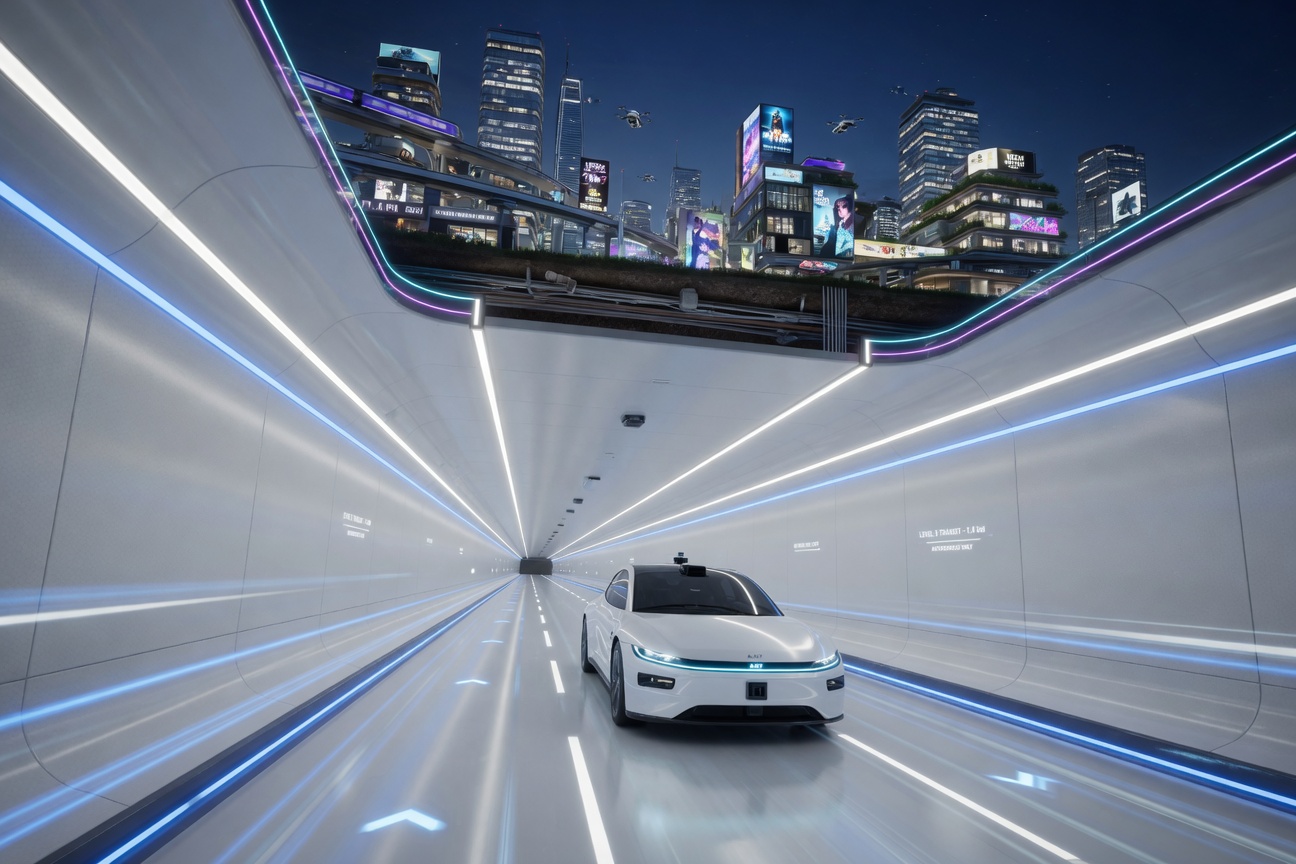
There is a moment, somewhere between the escalator descent and the Tesla door closing around you, when the Vegas Loop stops feeling like transportation and starts feeling like something else entirely. The tunnel hums. The city above vanishes. And in that sealed, climate-controlled capsule, you are no longer navigating Las Vegas, you are being delivered through it. That distinction, subtle as it sounds, may be the most culturally consequential thing The Boring Company has built so far.
We talk endlessly about tunnel transit as an engineering problem, a funding challenge, a throughput equation. What we talk about far less is what it does to the social grammar of a city when moving through it stops being a shared, messy, democratic act and becomes a curated, personalized, and increasingly privatized experience. That shift is already underway in Las Vegas. And if the 68-plus miles of tunnel projects currently in various stages of development across the United States proceed as planned, it will accelerate dramatically.
The Etiquette of Enclosure
Public transportation, for all its frustrations, has always been a crucible of urban identity. The subway platform is where a hedge fund analyst stands shoulder to shoulder with a hotel housekeeper. The bus aisle is where languages tangle and strangers briefly share the arithmetic of delay. Sociologists have long argued that these friction points, annoying as they are, perform a civic function. They are the micro-negotiations that remind city dwellers they inhabit shared space with people unlike themselves.
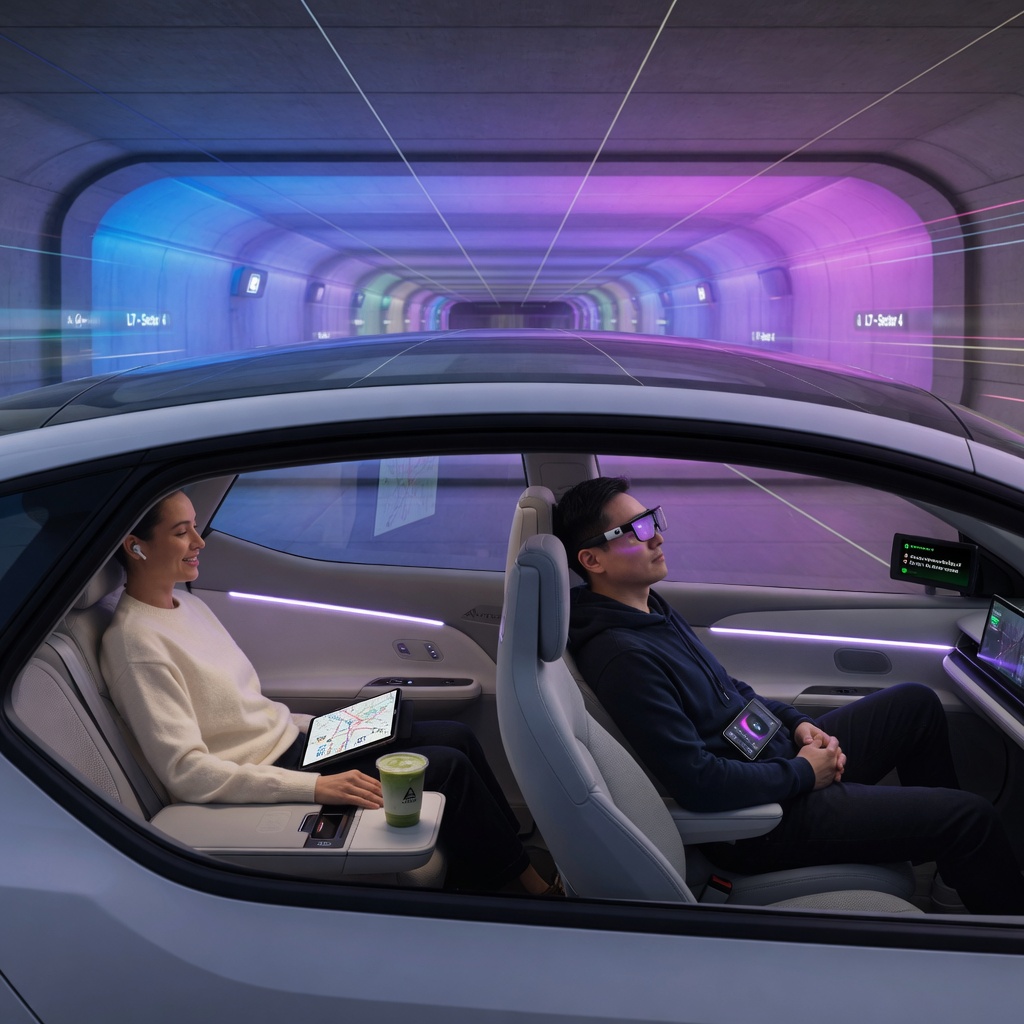
The Vegas Loop offers something architecturally opposed to that dynamic. Passengers board in small groups, often as a single party, inside a private vehicle. There is no communal car. There is no aisle. There is no one to accidentally make eye contact with. The experience is optimized for speed and comfort, and it largely succeeds on both fronts. But optimization has a shadow. What gets quietly removed in the pursuit of frictionless movement is exactly the friction that makes transit a social institution rather than a logistics service.
This is not a critique unique to The Boring Company. Ride-sharing platforms have been chipping away at the same norm for over a decade. But tunnels formalize the architecture of separation in a way that an Uber never quite could, because tunnels are infrastructure. They outlast apps. They shape cities for generations. Once you build the tube, you build the behavior that fills it.
Accessibility and the Myth of Universal Speed
Proponents of underground transit, and there are serious, thoughtful ones among them, argue that the equity calculus is more complicated than critics admit. They point out that conventional surface transit in American cities is itself profoundly inequitable, chronically underfunded, and spatially biased toward downtown corridors that serve white-collar workers. A tunnel network that gets people anywhere in a metro area in under fifteen minutes, regardless of neighborhood, could theoretically democratize mobility far more radically than another light rail line.
That argument has real weight. But it carries a silent precondition: the tunnel must actually serve everyone. And that is where the Vegas Loop's current configuration raises legitimate questions. The system today is concentrated in a tourism-industrial corridor connecting convention centers, sports arenas, and casino resorts. It is not, at present, connecting working-class neighborhoods in North Las Vegas to job centers, nor linking the city's substantial immigrant communities to healthcare or education hubs. The infrastructure exists where the economic incentive is strongest, which is almost never where the social need is greatest.
The Boring Company and its advocates would say that expansion is the plan, that the current footprint is a proof of concept that will eventually scale outward. That may be true. But the sequence matters enormously. Cities that build transit for tourists first and residents second tend to embed that priority into their spatial DNA. The tunnels that get built first determine the tunnels that get built next, because infrastructure follows infrastructure. Sewer lines precede housing developments. Highway interchanges birth shopping malls. Tunnel stations will beget tunnel stations, and the locations of the first generation will exert gravitational pull on the second.
Autonomy, Anonymity, and the New Urban Stranger
There is a parallel cultural transformation happening at the behavioral level, one that urban psychologists are only beginning to examine. When transit becomes individualized and automated, the role of the human driver is also transformed. For a century, the bus driver and the taxi driver occupied a specific social position in city life: they were navigators, witnesses, and informal guardians of public order. Cab drivers knew neighborhoods. Bus operators recognized regulars. They were, in a modest but real way, connective tissue.
"What gets quietly removed in the pursuit of frictionless movement is exactly the friction that makes transit a social institution rather than a logistics service."
In an autonomous tunnel system, that figure disappears. The vehicle becomes an agent of pure logistics. And passengers, cocooned inside, become data points in a routing algorithm. This is not inherently dystopian. But it does represent a genuine normative shift in what urban movement feels like and who is accountable for it. When something goes wrong in a driverless tunnel, who do you yell at? When a passenger behaves dangerously, who intervenes? These are not hypothetical edge cases. They are the daily texture of transit life, and systems that eliminate human mediation must replace it with something.
The Aesthetics of Going Under
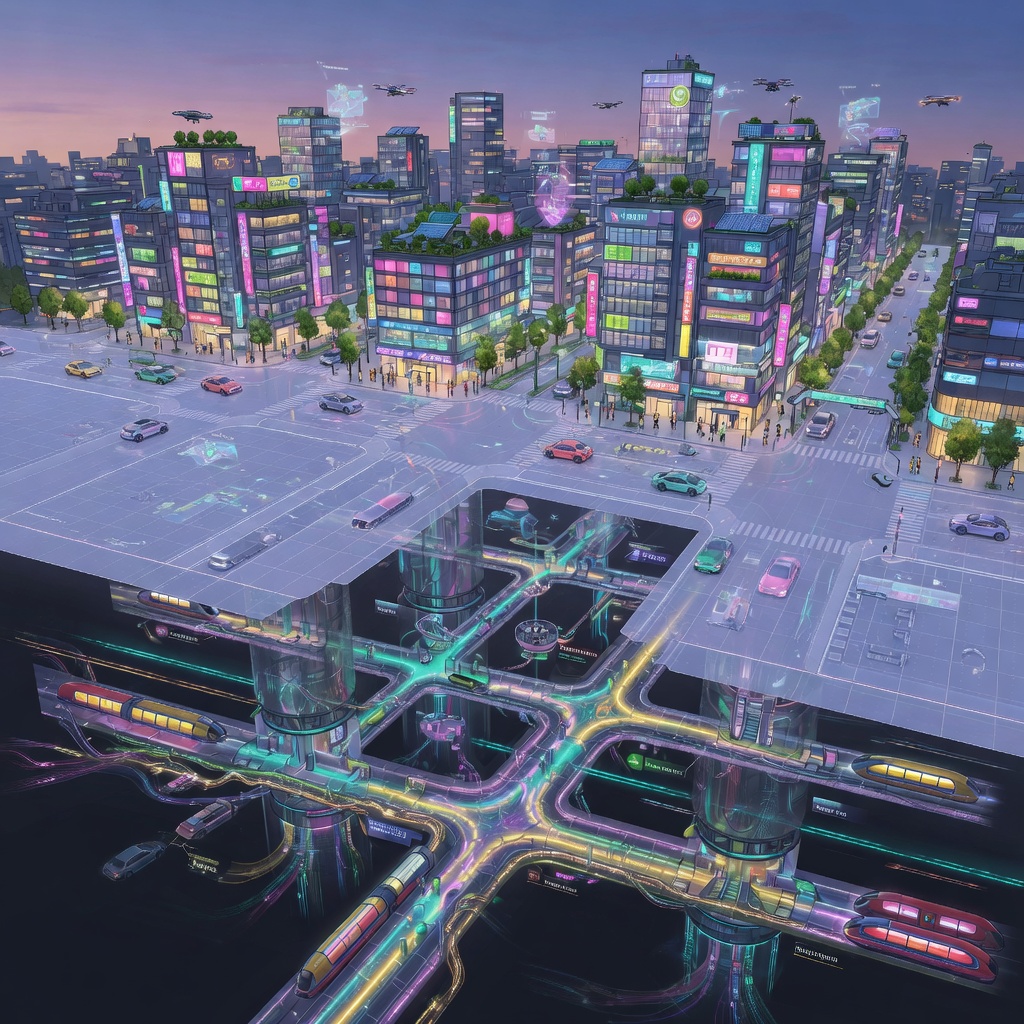
Above ground, cities perform themselves. Streets are theater. Sidewalks are stages. The visual noise of a city in motion, its taxis and buses and cyclists and pedestrians, tells a story about its social texture, its wealth distribution, its demographic complexity. This visible mobility is not incidental. It is one of the primary ways a city communicates its character to itself and to visitors.
When significant flows of people go underground, particularly the higher-income or tourism-oriented flows that tend to anchor early tunnel networks, the street-level performance changes. This has already happened in parts of downtown Las Vegas, where the Loop has reduced surface-level pedestrian flows between certain venues. Early data suggests this is modest for now. But urbanists who study the long arcs of city morphology point to analogous patterns: the construction of elevated highways in mid-twentieth-century American cities, which were sold as efficiency upgrades but ended up severing street-level commercial activity and hollowing out neighborhood retail.
The tunnel is the inverse of the highway overpass, physically, but the dynamic risk is structurally similar. Move people through a space without exposing them to it, and the space they bypass stops mattering economically. The businesses along the route suffer. The street life attenuates. The city above the tunnel becomes a surface that exists primarily for people who cannot afford or do not qualify for the faster path underneath.
Reframing the Question We Should Be Asking
None of this means tunnel transit is a bad idea. The engineering is genuinely impressive, the operational costs are lower than critics predicted, and the environmental case for moving vehicles underground and off congested surface arterials has merit. What it means is that the cultural and ethical questions surrounding underground transit deserve the same rigorous public attention that we give to its technical specifications.
We have never, as a society, fully reckoned with what mobility justice means in an era of radically individualized transportation. The car promised personal freedom and delivered it, along with sprawl, pollution, and the slow strangulation of walkable urbanism. Tunnel transit is not a car, but it shares some of the car's core assumption: that the ideal urban journey is one that insulates you from everything you did not choose to encounter.
Before the next shovel breaks ground, before the next city council approves the next loop expansion, the conversation that cities need to have is not just about tunnels. It is about what kind of urban society they want to build. Do they want infrastructure that moves people faster, or infrastructure that moves a city forward? Those are not always the same direction, and the difference runs deeper than any tunnel yet dug.