
Who Governs the Final Frontier? The Regulatory Reckoning Facing SpaceX's Cosmic Ambitions
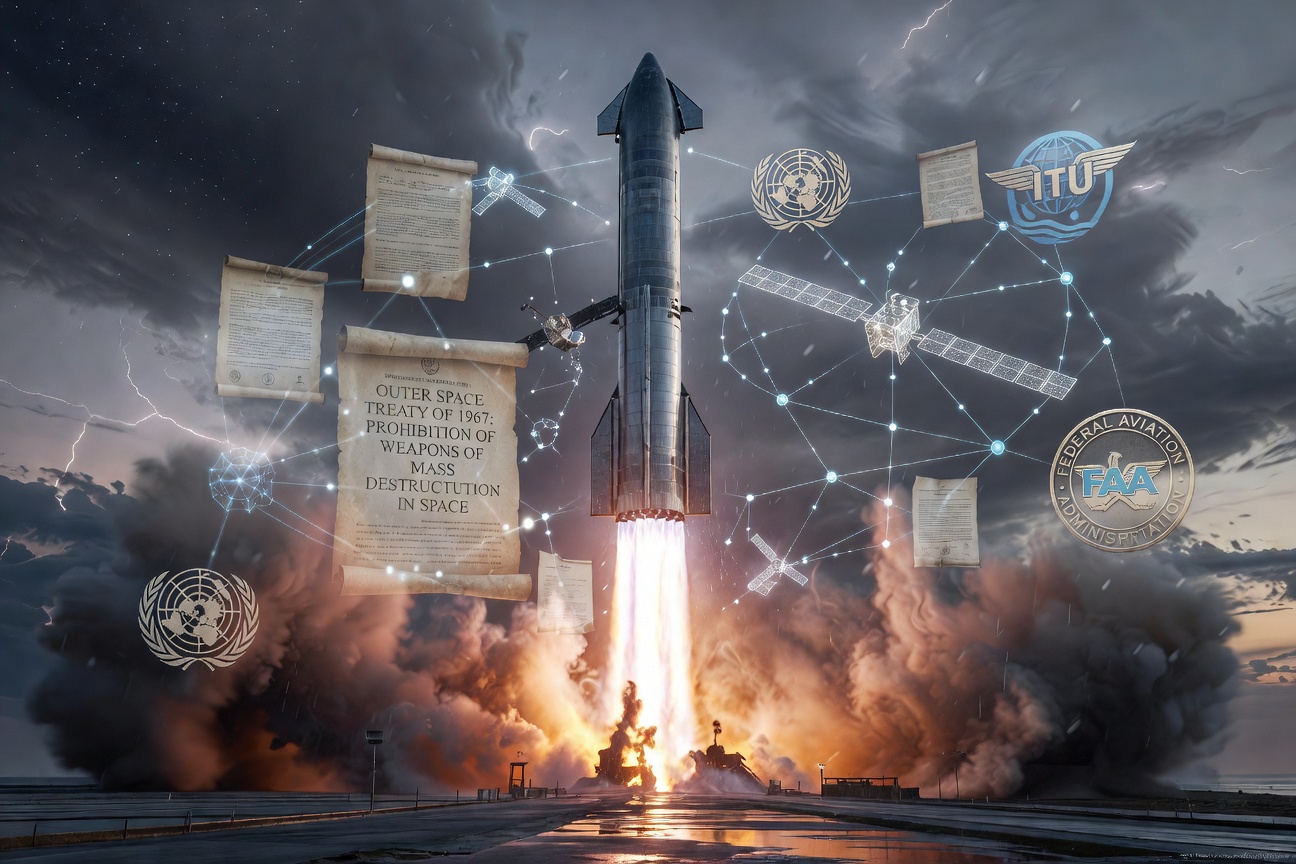
Space, humanity has long agreed, belongs to no one nation and every nation simultaneously. That elegant fiction, enshrined in the 1967 Outer Space Treaty, was crafted in an era when only superpowers could afford a launch pad. Now a single private company — SpaceX — is operating the world's most powerful rocket, blanketing low-Earth orbit with thousands of internet satellites, ferrying NASA astronauts to the Moon under the Artemis program, and openly blueprinting a colony on Mars. The legal and regulatory infrastructure governing all of this? Largely the same patchwork assembled before the internet existed.
The FAA's Impossible Mandate
The Federal Aviation Administration's Office of Commercial Space Transportation was never engineered for this moment. Originally conceived to license the occasional commercial launch, the office now finds itself the primary gatekeeper for Starship — the most complex, most powerful, and most consequential rocket program in history. Each Starship integrated flight test requires an environmental review, a safety analysis, and a launch license that can take months to process, a timeline that SpaceX's engineering cadence renders almost comically slow.
After the fourth Starship test flight in June 2024 demonstrated successful booster catch attempts and controlled splashdowns, SpaceX began pushing for a dramatically accelerated licensing rhythm. The FAA, caught between its statutory obligation to protect public safety and intense political pressure to not stifle American aerospace innovation, has become a reluctant referee in a game it did not design. Critics on Capitol Hill accuse the agency of regulatory overreach. Critics in the scientific community accuse it of capitulating to corporate momentum. The FAA, for its part, insists it is simply following the law — which is precisely the problem, because the law was never written with Starship in mind.

Starlink and the Spectrum Wars
If Starship is the regulatory pressure cooker, Starlink is the slow boil. With over 6,000 satellites now in orbit and approval sought for tens of thousands more across multiple orbital shells, SpaceX's internet constellation has triggered an unprecedented collision of interests at the International Telecommunication Union, at the FCC, and in the corridors of every space agency on Earth.
The core tension is orbital real estate and radio frequency spectrum — both finite resources governed by rules drafted for a world where satellites were rare and expensive. Traditional operators, including European and Asian telecommunications companies with legacy geostationary assets, argue that Starlink's sheer density degrades their ability to operate. Astronomers, backed by the International Astronomical Union, have documented measurable interference with ground-based telescope observations, triggering ongoing negotiations about satellite brightness standards and orbital maneuvering protocols that SpaceX participates in but is not legally bound to obey beyond FCC license conditions.
The geopolitical dimension is equally fraught. Russia and China have formally objected to Starlink's architecture at the ITU, framing it as an attempt by the United States to monopolize low-Earth orbit under commercial cover. Those objections carry ideological weight but limited legal force. What they do accomplish is poisoning the diplomatic well for future multilateral space governance agreements at a moment when such agreements are desperately needed.
Artemis: NASA's Contractor, Everyone's Moon
The Artemis program places SpaceX at the center of America's return to the Moon, and with it, at the center of one of the most contested governance questions in modern space policy: what rights does a private company acquire when it lands on a celestial body?
NASA awarded SpaceX the Human Landing System contract for Artemis III, the mission intended to return astronauts to the lunar surface. The contract is enormous, the engineering challenge is real, and the timeline remains ambitious. But embedded within the program's structure is a question that no existing treaty cleanly resolves. The Artemis Accords, a U.S.-led bilateral agreement now signed by over 40 nations, establish norms around lunar resource extraction, the designation of safety zones, and the preservation of heritage sites like the Apollo landing areas. They are not, however, binding international law. China and Russia have declined to sign, preferring instead to develop their own lunar program and governance framework.
What this means practically is that when Artemis astronauts land on the Moon aboard a SpaceX vehicle, they will be operating under a patchwork of U.S. domestic law, voluntary international commitments, and the skeletal framework of the 1967 treaty. If SpaceX, as a contractor, eventually pursues lunar resource extraction activities tangential to its NASA missions, the legal basis for those activities remains genuinely ambiguous. The company would be operating under a U.S. license, in a domain that international law declares the province of all mankind, with no international court possessing clear jurisdiction to adjudicate disputes.

Mars: The Governance Void at the End of the Solar System
If the regulatory situation around Starship, Starlink, and the Moon is complicated, the governance framework for Mars colonization is essentially nonexistent. Elon Musk has been explicit about his ambition to establish a self-sustaining Martian city within the coming decades. SpaceX's internal planning documents and public roadmaps describe not just transportation infrastructure but political structures — the suggestion that Mars, given communication delays, would need to be self-governing and that Earth-based legal frameworks should not automatically apply.
That position, however casually floated, is a direct challenge to the foundational premise of international space law: that spacefaring states bear responsibility for the activities of their nationals and registered objects, wherever those activities occur. If SpaceX establishes a Martian settlement, the United States government is, under current law, the responsible party. Whether the U.S. has the appetite or the capacity to regulate a colony tens of millions of miles away is a different question entirely.
Legal scholars have begun mapping what a Martian governance framework might look like. Proposals range from extending existing U.S. territorial law to treating a Martian settlement as analogous to an Antarctic research station under international treaty. None of these frameworks were designed for a scenario involving thousands of permanent residents, commercial property rights, or the kind of economic activity that a self-sustaining city implies. The gap between SpaceX's timeline and the pace of international legal development is not measured in years. It may be measured in generations.
Stakeholders: Winners, Losers, and the Unrepresented
The regulatory battles surrounding SpaceX's programs do not occur in a vacuum. They produce clear winners and losers, and the distribution is rarely discussed with adequate frankness. Traditional launch providers — United Launch Alliance, Arianespace, and the emerging cohort of new-space startups — operate within a regulatory framework that SpaceX's scale and lobbying presence has effectively shaped to its advantage. Competitors seeking launch licenses face the same FAA processes but lack SpaceX's institutional relationships and congressional allies.
Developing nations represent perhaps the most underrepresented stakeholder class in this entire regulatory ecosystem. Countries in the Global South have no meaningful voice in ITU spectrum allocation battles dominated by wealthy-nation incumbents and American commercial interests. They have no seat at the table in Artemis Accords negotiations that will shape the legal norms governing lunar resources their own future space programs might wish to access. And they have no mechanism to influence what happens on Mars, a world that will, if Musk's vision is realized, be settled almost exclusively by people from wealthy, technologically advanced societies.
The academic and scientific community occupies an uncomfortable middle position. Researchers depend on Starlink's global connectivity for remote data collection and benefit from SpaceX's low-cost launch services for small satellite missions. They simultaneously bear the costs of Starlink's impact on observational astronomy and worry about the precedents being set for commercialization of the orbital environment.
The Clock is Running
Regulatory systems, by design, lag behind technological change. That lag is sometimes a feature, providing stability and predictability. In the domain of space, at this particular historical inflection point, it is becoming a dangerous vulnerability. SpaceX is not waiting for governance to catch up. Its launch cadence, its satellite deployment rate, and its Mars planning timelines are set by engineering logic and market opportunity, not by the pace at which international bodies can reach consensus.
The window for establishing coherent, equitable, and durable governance frameworks for commercial space activity is narrowing with every Starship test flight. The stakeholders who will ultimately be most affected — future generations, developing nations, the scientific community, and the settlers of worlds not yet reached — have the least power in the rooms where decisions are currently being made. That asymmetry, more than any technical challenge, may prove to be the most consequential feature of humanity's expansion into the cosmos.