
No Driver Required: Inside Tesla's Audacious Bet on a Driverless Future
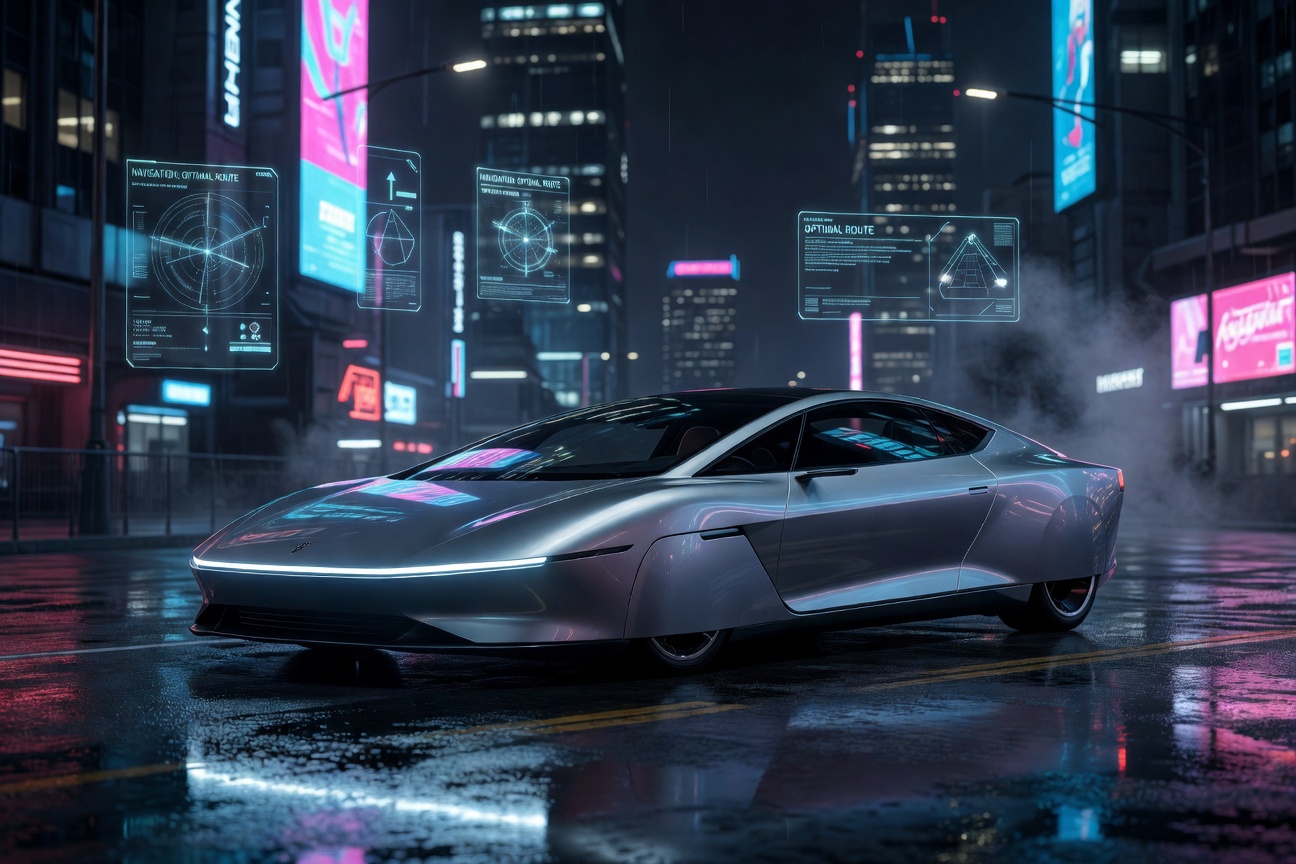
Picture this: it's a Tuesday morning somewhere in suburban Austin, and a compact, wedge-shaped vehicle with no steering wheel and no driver silently pulls up to a curb. A passenger climbs in, speaks a destination, and the car slides back into traffic with the calm precision of a chess grandmaster three moves ahead of the board. No idle chatter. No surge pricing negotiation. No moment of existential uncertainty about whether the human behind the wheel slept enough. This is not a scene from a streaming sci-fi series. It is, according to Tesla's public roadmap and the engineering momentum building inside its AI division, somewhere between eighteen months and five years away from being mundane.
The Machine That Changes the Equation
Tesla's Cybercab is not simply a new car model. It is a declaration of intent rendered in stamped metal and neural network weights. Unveiled to considerable fanfare in late 2024, the vehicle strips away the redundancies that electric vehicles still carry from their combustion-era ancestors: no pedals, no manual override, no provisions for a licensed operator. The design is predicated entirely on the assumption that the software will always be good enough. That assumption, breathtaking in its confidence, is either visionary or reckless depending on which traffic safety researcher you ask on any given afternoon.
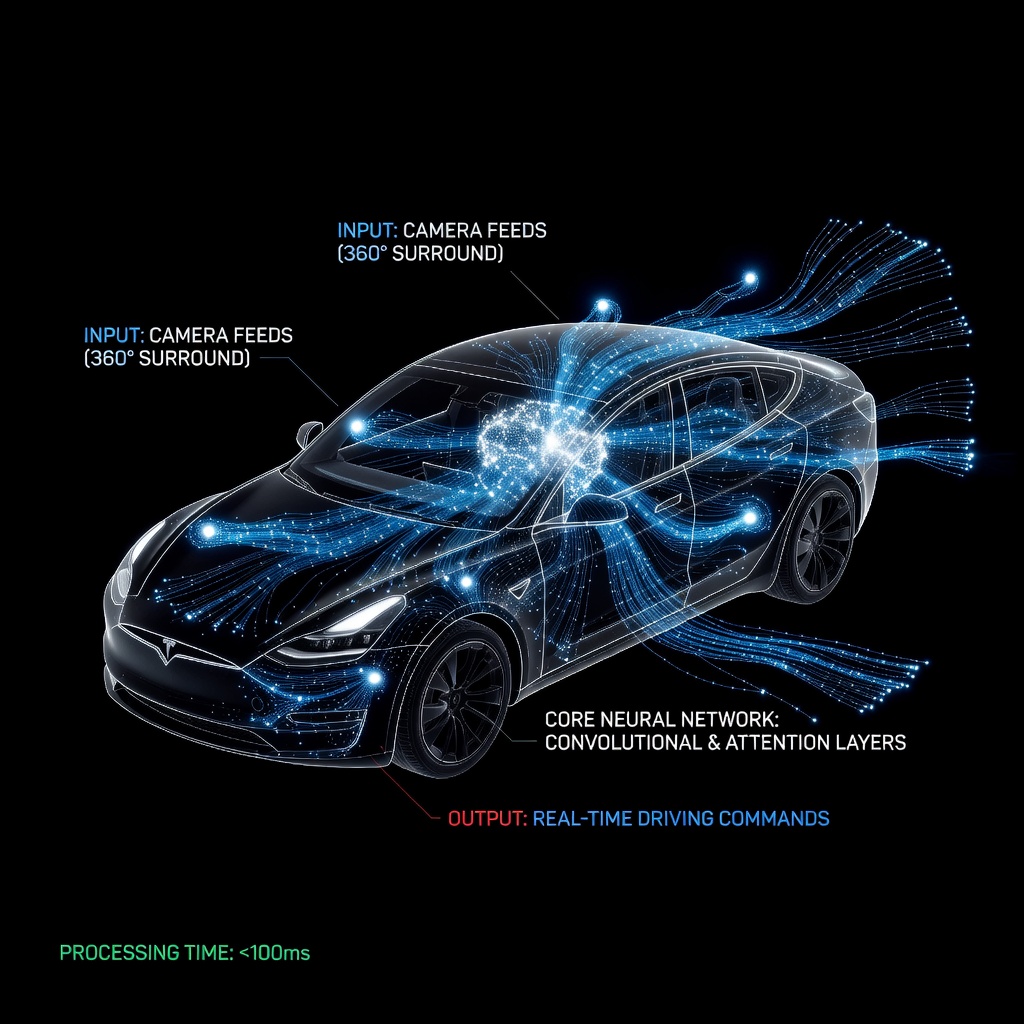
What makes the Cybercab architecturally distinct from competitors like Waymo's robotaxi fleet is Tesla's absolute commitment to a camera-only sensor stack. No lidar spinning on the roof, no radar arrays peppering the bumpers. Just eight cameras feeding a custom-designed AI chip called the FSD Computer, which processes roughly 144 trillion operations per second. Tesla engineers have long argued that lidar is a crutch, an expensive shortcut that teaches cars to navigate a world defined by point clouds rather than the visual reality that human drivers actually inhabit. The rest of the autonomous vehicle industry has largely disagreed. The market, eventually, will adjudicate.
FSD: From Party Trick to Platform
Full Self-Driving, Tesla's driver-assistance software that has occupied the company's engineering ambitions for nearly a decade, has had a complicated relationship with credibility. Early versions required constant correction, produced occasional white-knuckle moments on highways, and attracted the skepticism of safety regulators who bristled at the marketing language wrapped around what was, technically, a Level 2 driver-assistance system. The driver was always supposed to be watching. Frequently, they were not.
But versions 12 and beyond marked a qualitative shift that even critics have acknowledged. The architecture migrated away from hand-coded rules toward an end-to-end neural network approach, meaning the system ingests raw camera footage and outputs steering, acceleration, and braking decisions without an intermediate layer of human-designed logic. The car, in a real sense, learned to drive the way a person does, by watching and doing, rather than by following a rulebook. Interventions per mile dropped sharply. Behavior in complex urban intersections, the historically brutal test case for autonomous systems, became markedly more fluid.
Tesla claims its global fleet has accumulated more than three billion miles of FSD-enabled driving data. That number is not merely a marketing statistic. It is the raw material from which the system's competence is being continuously distilled. Every phantom brake, every hesitation at an ambiguous lane merge, every perfectly executed unprotected left turn feeds back into a training pipeline that runs around the clock inside Tesla's Dojo supercomputer clusters. The scale of this data flywheel is something no startup, and few established competitors, can replicate.
The Network Effect That Nobody Is Talking About
Here is where Tesla's robotaxi ambitions become genuinely difficult to dismiss on purely technical grounds. The company is not merely building one autonomous vehicle. It is building a network effect. Every Tesla on the road today, the 6 million-plus vehicles with FSD hardware installed, is simultaneously a revenue-generating asset and a data-collection instrument. When Cybercab launches commercially, it will not enter the world as a prototype feeling its way through unfamiliar territory. It will inherit an accumulated institutional knowledge base that has been stress-tested on the streets of Mumbai, São Paulo, Oslo, and Phoenix.
Elon Musk has framed the robotaxi network in explicitly economic terms, and the numbers, if they prove achievable, are staggering. He has suggested that Cybercab could generate somewhere between thirty thousand and fifty thousand dollars in gross profit per vehicle per year for operators who deploy them on the Tesla network, figures that would make ownership economics look less like buying a car and more like acquiring a small franchise. Individual Tesla owners, the theory goes, could dispatch their personal vehicles to earn money autonomously while they sleep. The car becomes an appreciating income-generating asset rather than a depreciating parking lot ornament.
This peer-to-peer revenue model is the piece of the strategy that distinguishes Tesla most sharply from Waymo, which operates a centrally managed fleet, or from the ride-hailing giants Uber and Lyft, which rely on human drivers and take a commission cut. If Tesla succeeds in making vehicle ownership synonymous with passive income, it fundamentally restructures the incentive landscape for buying an electric car.
The Regulatory Labyrinth and the Texas Gambit
No amount of engineering brilliance operates outside the political and regulatory atmosphere, and autonomous vehicle deployment remains one of the most legally fractured landscapes in American infrastructure. California, arguably the most important proving ground for AV technology, has already granted commercial robotaxi permits to Waymo and granted, then complicated, similar aspirations for other operators. Tesla has conspicuously chosen Texas, specifically Austin, as its initial Cybercab launch market, and the choice is not accidental.
Texas operates under a comparatively permissive regulatory framework for autonomous vehicles. The state does not require special permits for AVs to operate commercially, relying instead on existing traffic law and liability frameworks. This is not a loophole so much as a deliberate legislative posture from a state that has enthusiastically courted Tesla's manufacturing presence. The Austin launch, reportedly targeting a small supervised fleet in mid-2025 before expanding, is as much a regulatory stress test as a commercial one.
What happens when a Cybercab is involved in an accident in a jurisdiction without clear autonomous vehicle liability law? Who pays? The owner? Tesla? The passenger? These questions do not have clean answers yet, and the legal infrastructure surrounding autonomous commercial transport is evolving at a pace that would make a DMV clerk nervous. Tesla's bet is that the technology's safety record will outpace the regulatory friction, that enough miles accumulated without catastrophic failure will generate the political permission structure that formal rulemaking has not yet provided.
Competitors Are Not Sleeping
Waymo, backed by Alphabet's deep pockets, continues to expand its commercial operations in San Francisco, Los Angeles, and Phoenix with a methodical patience that stands in philosophical contrast to Tesla's velocity-first culture. Waymo's vehicles accumulate far fewer miles than Tesla's global fleet, but those miles are extraordinarily well-documented, geofenced, and mapped with centimeter-level precision. Its safety record, while not perfect, has been notably strong, and it carries a regulatory credibility that Tesla's FSD program is still working to build.
Meanwhile, Chinese competitors including Baidu's Apollo and the Pony.ai network are deploying robotaxis at scale in Beijing and Guangzhou under regulatory frameworks that move faster than their Western counterparts. The geopolitical implications of a Chinese company achieving commercial autonomous ride-hailing dominance before American competitors do not require elaborate unpacking.
What the Next Eighteen Months Actually Tell Us
The honest answer to the question of whether Tesla's robotaxi network will transform urban mobility or become an expensive lesson in overconfidence is: we are about to find out in real time. The Cybercab's commercial debut, the expansion of unsupervised FSD to additional markets, the reaction of insurance companies, the response of municipal governments, and the actual behavior of the public when asked to trust a machine with their lives on the commute to work will collectively produce more signal than a decade of analyst speculation.
What is already evident is that the conversation has permanently shifted. The question is no longer whether autonomous vehicles will become a mainstream commercial reality. It is which architecture, which business model, and which company will define the terms of that reality. Tesla has placed a very large, very public wager on the answer. The meter is running, and nobody is in the driver's seat.
Alex Rivera
Tech journalist covering Elon Musk’s companies for over 8 years.